



Photography: Kim Tieleman
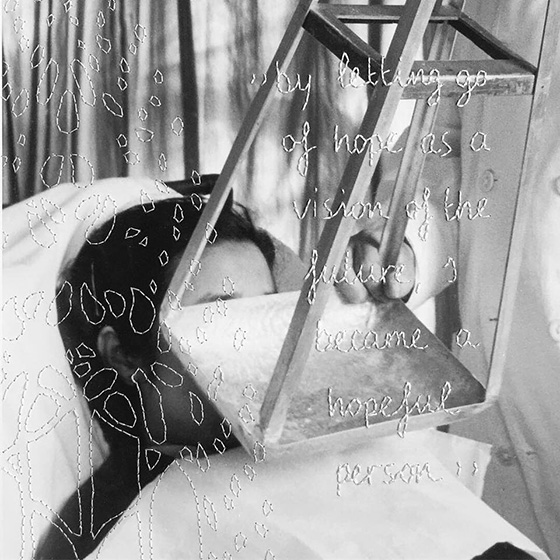
In samenwerking met fotograaf Kim Tieleman heb ik het drieluik “Perpetual present” gemaakt. We hebben foto’s gebruikt uit het Nationale Archief / Collectie Spaarnestad en quotes gebruikt van 3 schrijvers. De foto’s zijn bewerkt met glowinthedark-borduurgaren.
Het werk gaat over hoop en overgave. Wat als je geen toekomst hebt…
In collaboration with photographer Kim Tieleman I made triptych “Perpetual present”.
We used pictures from the National Archive / Collection Spaarnestad and quotes from 3 writers. The pictures are edited with glowinthedark- embroidery.
The work is about hope and surrender. What to do if you have no future…
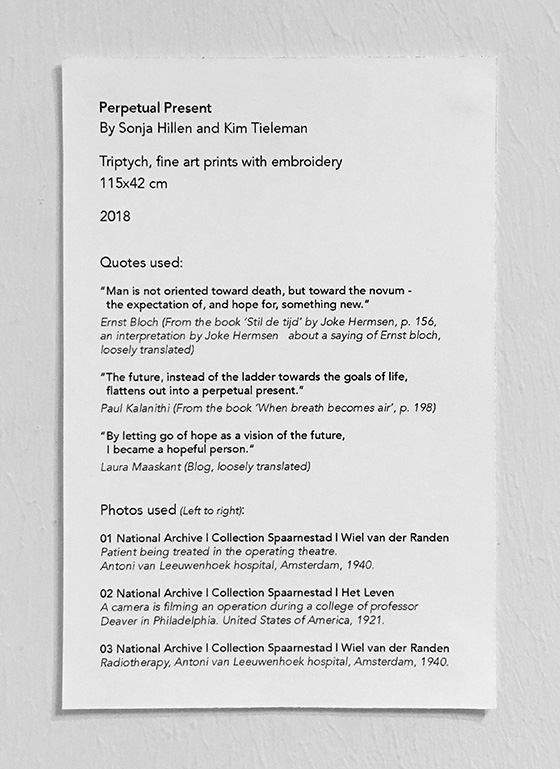
Perpetual Present
By Sonja Hillen and Kim Tieleman
Triptych, fine art prints with embroidery
115 x 42 cm, 2018
Perpetual Present is een drieluik over hoop en overgave binnen het ziekteproces.
Het drieluik onderzoekt hoe je je als patiënt verhoudt tot een medische werkelijkheid die gericht is op genezing, terwijl tegelijkertijd de eindigheid van het leven voelbaar wordt. Het werk reflecteert op de veranderende betekenis van hoop en op de vraag hoe je betekenis en houvast vindt wanneer genezing buiten bereik is.
Voor dit drieluik hebben wij medische archieffoto’s gecombineerd met borduurgaren. De foto’s laten mensen zien binnen verschillende medische situaties, waarin zij zich overgeven aan behandelingen, medische apparatuur en de medische blik. Met naald en draad zijn over de foto’s kapelramen van glas-in-lood en drie citaten over hoop geborduurd. Het borduurwerk loopt over de afzonderlijke foto’s heen en verbindt ze met elkaar tot één drieluik. (Het gebruikte borduurgaren is lichtgevend en licht op in het donker, waardoor het werk in het donker een andere verschijningsvorm krijgt.)
De titel Perpetual Present is ontleend aan een citaat van Paul Kalanithi uit When Breath Becomes Air, dat ook in het werk is verwerkt: “The future, instead of the ladder towards the goals of life, flattens out into a perpetual present.”
Het werk nodigt uit om stil te staan bij het stervensproces en de vraag hoe je de laatste fase van het leven wilt ingaan. Wanneer hoop niet langer gericht kan zijn op genezing, waar vind je dan betekenis en houvast?
Perpetual Present is a triptych about hope and surrender within the illness process.
The triptych explores how you, as a patient, relate to a medical reality aimed at healing, while simultaneously the finitude of life becomes palpable. The work reflects on the changing meaning of hope and on the question of how to find meaning and stability when healing is out of reach.
For this triptych, we combined archival medical photographs with embroidery thread. The photos show people within various medical situations, in which they surrender to treatments, medical equipment, and the medical gaze. Stained-glass chapel windows and three quotes about hope have been embroidered over the photos using needle and thread. The embroidery runs across the individual photos, connecting them to form a single triptych. (The embroidery thread used is luminous and glows in the dark, causing the work to take on a different appearance in the dark.)
The title Perpetual Present is taken from a quote by Paul Kalanithi from *When Breath Becomes Air*, which is also incorporated into the work: “The future, instead of the ladder towards the goals of life, flattens out into a perpetual present.”
The work invites reflection on the dying process and the question of how one wishes to enter the final phase of life. When hope can no longer be focused on healing, where do you find meaning and stability?
Quotes used:
“Man is not oriented toward death, but toward the novum – the expectation of, and hope for, something new.”
Ernst Bloch (From the book ‘Stil de tijd’ by Joke Hermsen, p. 156, an interpretation by Joke Hermsen about a saying of Ernst Bloch, loosely translated)
“The future, instead of the ladder towards the goals of life, flattens out into a perpetual present.”
Paul Kalanithi (From the book ‘When breath becomes air’, p. 198)
“By letting go of hope as a vision of the future, I became a hopeful person.”
Laura Maaskant (Blog, loosely translated)
Photos used (Left to right):
01 National Archive | Collection Spaarnestad | Wiel van der Randen
Patient being treated in the operating theatre.
Antoni van Leeuwenhoek hospital, Amsterdam, 1940.
02 National Archive | Collection Spaarnestad | Het Leven
A camera is filming an operation during a college of professor
Deaver in Philadelphia. United States of America, 1921.
03 National Archive | Collection Spaarnestad | Wiel van der Randen
Radiotherapy, Antoni van Leeuwenhoek hospital, Amsterdam, 1940.